Matheus Tavares Bernardino, an undergraduate student working in our group, presented his work on the acceleration of black hole radiative transfer with OpenACC in GPUS at the undergraduate science symposium at USP and now will compete in the international phase of the symposium which will happen in November.
Congratulations, Matheus!
Matheus (right) and collaborator Alfredo Goldmann (left) happily showcasing the poster
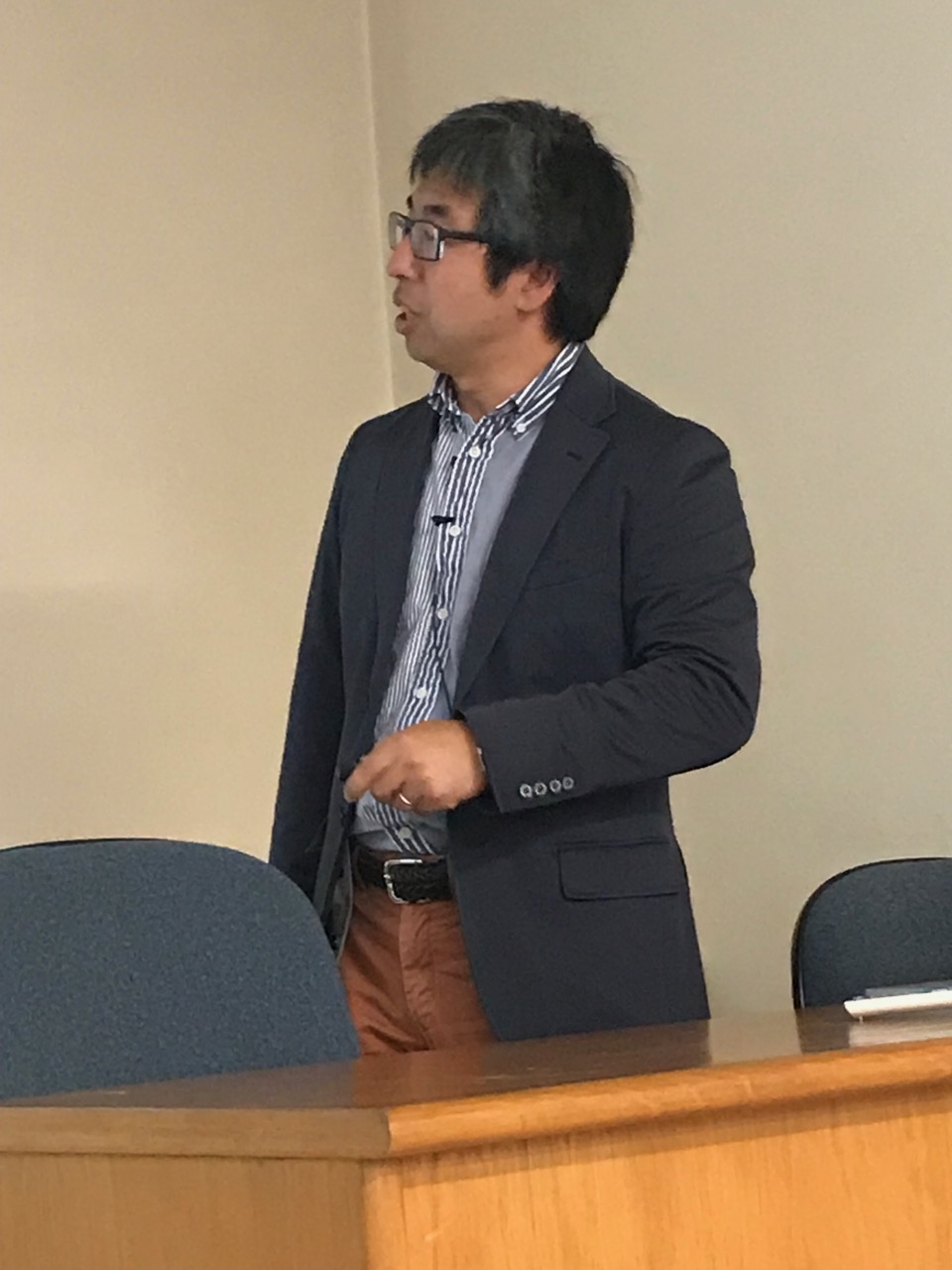
Yosuke Mizuno (Goethe University, Frankfurt) taught an advanced course on general relativistic magnetohydrodynamics on August 13-17 at our institute. General relativistic magnetohydrodynamics—or GRMHD—is an essential tool to model high-energy astrophysical phenomena such as accreting black holes and relativistic jets—precisely the type of phenomena that our group loves and cherishes. This course was very useful for everybody in the group.
Our PhD student Gustavo Soares will be visiting the Department of Physics & Astronomy at Northwestern to work under the supervision of Prof. Alexander Tchekhovskoy for six months. Gustavo will continue his work on general relativistic MHD simulations of accretion black holes and their radiative signatures. Have a productive visit, Gustavo!
On the final week of July, members of our research group (Fabio, Raniere & Rodrigo) will be teaching a lesson on the analysis of Fermi LAT gamma-ray observations in the School and Workshop on Dark Matter and Neutrino Detection at ICTP-SAIFR. In this hands-on activity, we will teach how to analyze gamma-ray data for a dwarf galaxy, do a simple estimate of the dark matter cross section and reproduce the analysis described in Ackermann et al. (2015).
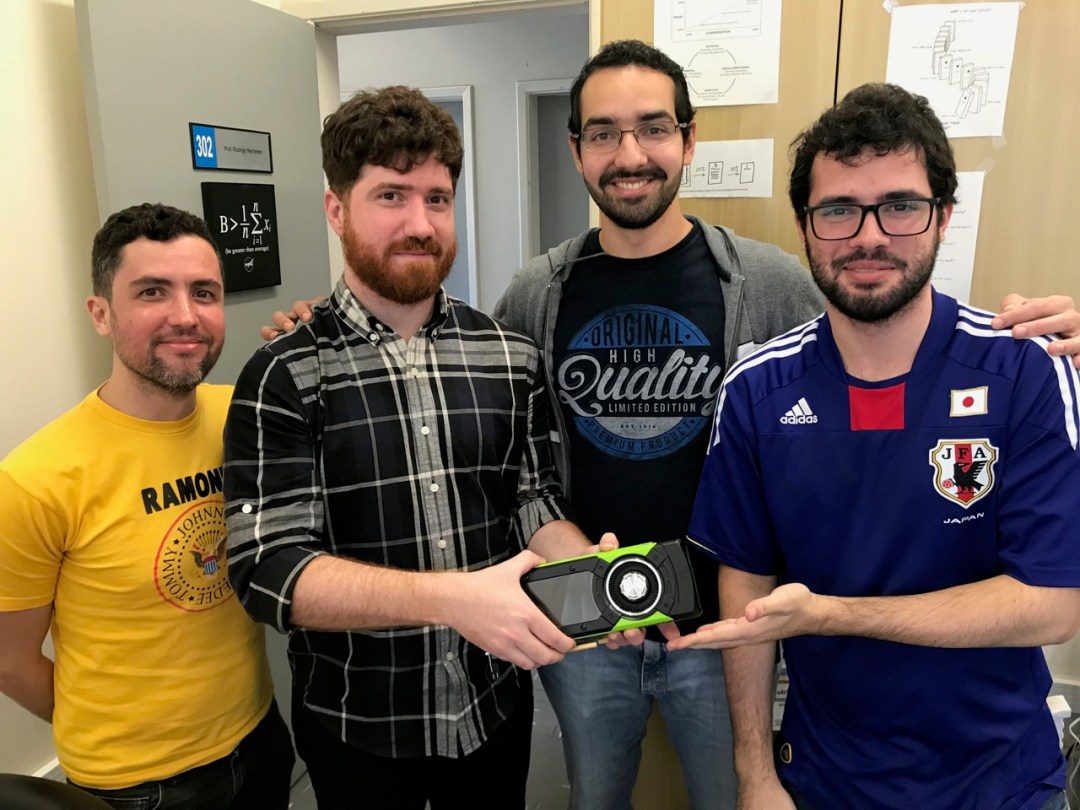
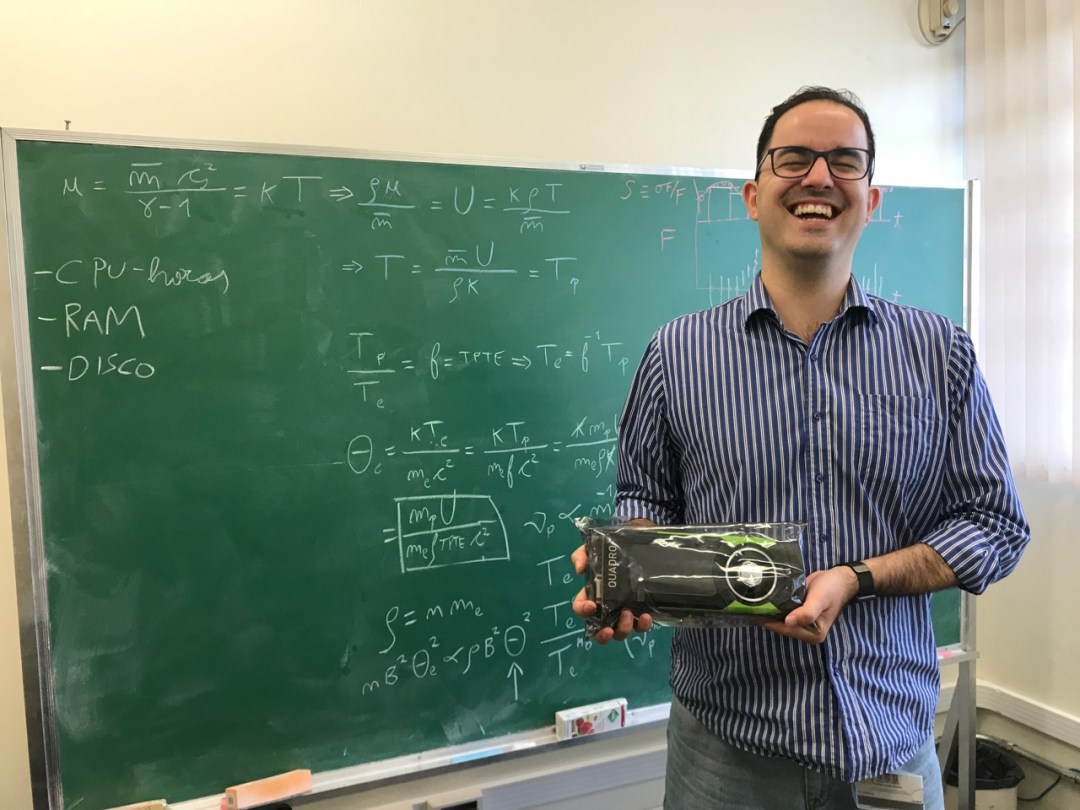
I am excited to announce that today we received a generous donation from NVIDIA through its GPU Grant Program, which will allow us to accelerate our science to another scale. We received a Quadro P6000 GPU, packing a powerful punch of 12 TFLOPS of FP32 processing power and 24 GB. This GPU will allow us to severely speed up the calculations of electromagnetic spectra from black holes that our group is developing. One estimate that always amazes me: this GPU is almost faster than the whole computer cluster—called Alphacrucis—that our institute hosts, which has 2300 CPUs (~20 TFLOPS) and was purchased in 2011.
Thanks to NVIDIA for the great gift, which will soon be put to good use. Let’s see those fans spin at maximum RPM! Science!
Some of the grad students in our group with the new GPU donated by NVIDIA. From left to right: Fabio, Gustavo, Raniere and Ivan.Rodrigo happily holding the Quadro GPU
Last Friday we had a group meeting with João Paulo Navarro from NVIDIA. João Paulo gave an OpenACC tutorial to the group, demonstrating how easy it is to accelerate scientific codes on GPUs. With just two lines of code (yes, I said two lines), we made a partial differential equation solver run almost 10x faster on a GPU! It is truly impressive.
We have great plans ahead, with some group projects where we anticipate huge speedups using GPUs. Stay tuned!
The Black Hole Group after the OpenACC training with J. P. Navarro (NVIDIA; sitting at the rightmost side).
Let’s congratulate Artur Vemado─the newest graduate student in the group─who got a prestigious FAPESP scholarship. Artur just graduated with an astronomy degree at USP. His project will consist of incorporating radiative cooling in the energy equation of hot accretion flows, in order to investigate state transitions in black hole binaries.
Last week, in collaboration with astrophysicists from USA and China, our group’s paper was accepted for publication in Monthly Notices of the Royal Astronomical Society (MNRAS). The paper is about the properties of the spectral energy density (SED) of the nearby galaxy NGC 3115, that hosts a billion solar mass black hole in a low-luminosity active galactic nucleus (LLAGN). Behind the spectrum of this galaxy there is a lot of information about the state of the gas flow around the supermassive black hole.
This work is a compilation of observational data of NGC 3115 nucleus followed by modeling of the spectrum considering the electromagnetic processes for the case of a radiatively inefficient accretion flow (RIAF), as the observation suggests. The main part of the work is the analysis of the radio emission that can be well-explained only considering the synchrotron emission from the RIAF, without the need of relativistic jet arising from the LLAGN,
The main result of the paper is a tight constraint on the density profile (ρ) of the accretion flow ρ(r) ∝ r -0.73 +0.01-0.02 which implies an important mass-loss via subrelativistic outflows (i.e. winds) in the RIAF. Our modeling suggests a nonthermal population of electrons in the flow too, similarly to SgrA*—the supermassive black hole in the center of our Galaxy—models.
The main plot of the paper. In the left the thermal SED. In the right is a zoom in radio region of spectrum: the red dash-dotted line is the thermal component of electron population and the blue dashed line is due to the nonthermal electron population, the black solid line is the resulting spectrum.
There is a FAPESP postdoctoral position opening for working in our group and collaborating with researchers at ICTP-SAIFR. This position is for a double appointment at USP and ICTP-SAIFR.
Review of applications will begin in January 2018 and will continue until all positions have been filled. Although there is no strict deadline, applications before December 15, 2017 are strongly recommended for positions to begin in 2018.




 Black Hole Group