
We finally got our new paper on GPUmonty out on arXiv! GPUmonty is a GPU-accelerated version of the grmonty code, ported over to CUDA to handle relativistic Monte Carlo radiative transfer way faster. We managed to get a speedup of over 10x compared to the CPU version, which makes a massive difference when you’re trying to run large parameter surveys for black hole modeling. In the paper, we go through all the benchmarking and tests to show it keeps the same accuracy while cutting down the computation time significantly. The code is also publicly available on our GitHub page, so feel free to check it out! We also have a documentation page with a quick start and documenting the functions of the code.
Blog
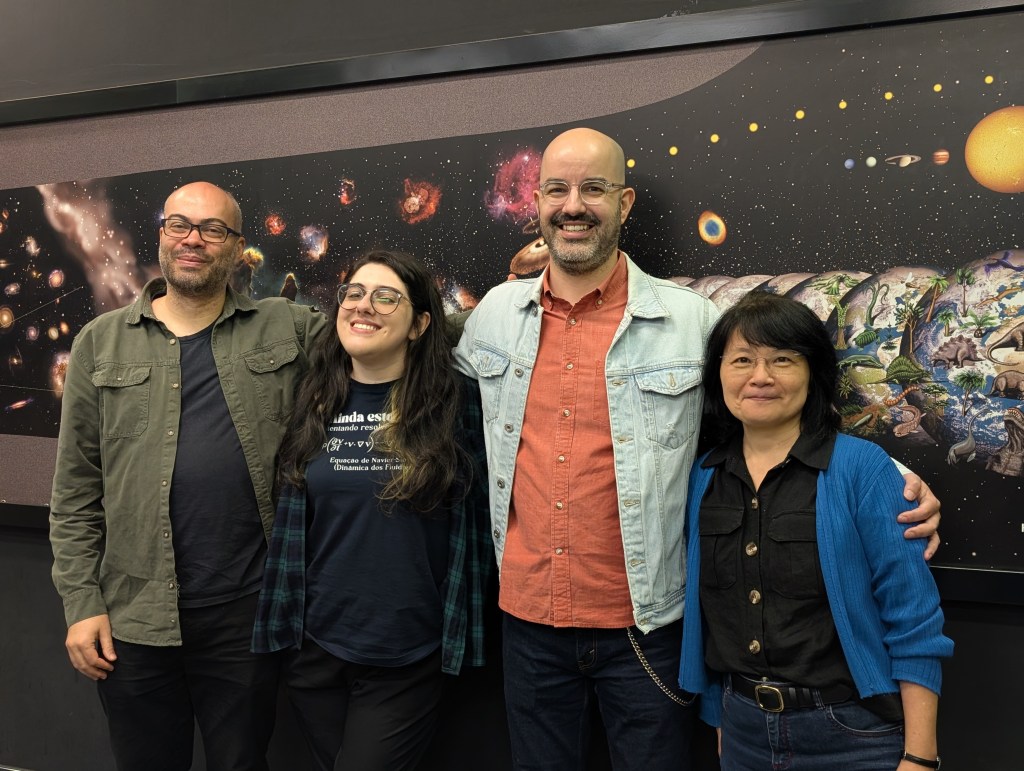
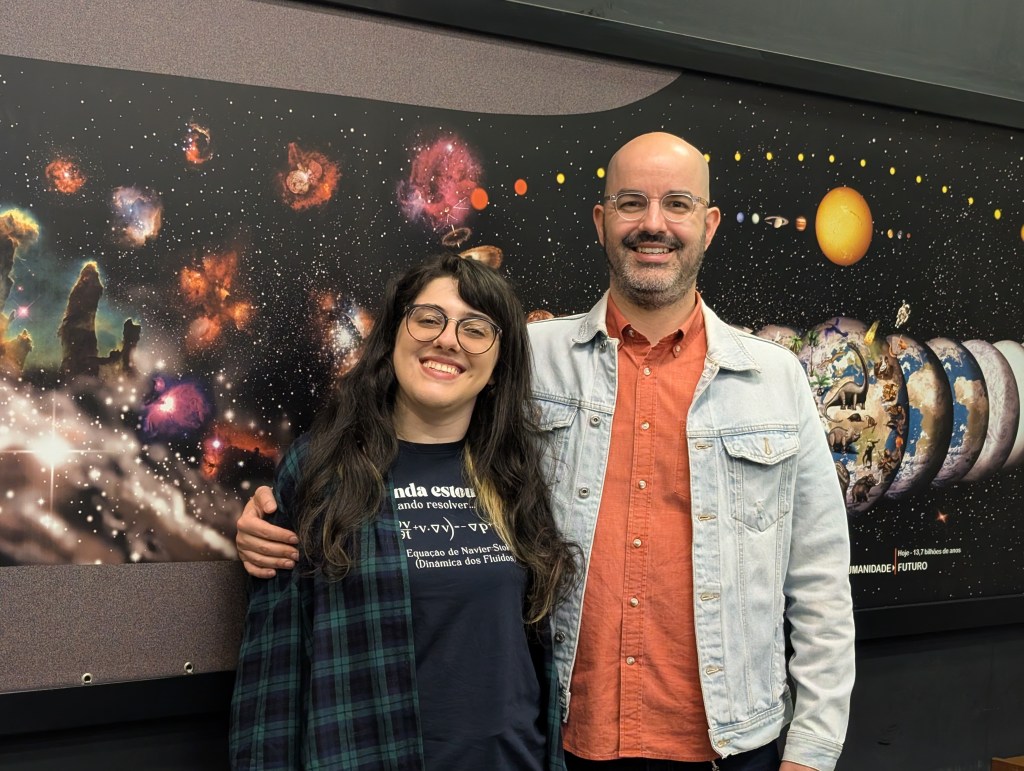
Roberta defended her PhD
On June 2nd 2025, Roberta Duarte defended her PhD on operator learning applied to magnetohydrodynamics.
Operator learning is a cutting-edge machine learning technique where we devise a model to learn the operator solution of partial differential equations rather than learning the solutions themselves. Roberta adapted the Fourier neural operator technique to learn to forecast the time evolution of the Orszag-Tang vortex, a classical problem in MHD and used to benchmark and test every numerical MHD code that exists because of the onset of turbulence and shocks.
Roberta beautifully gave her PhD thesis talk and handled questions from the five committee members. The defense started at 2:15pm local time, and ended at 6pm. Yes, a long defense, with rich conversations and discussions.
Congratulations, Dr. Duarte!


We submitted a paper reporting these results. Stay tuned for news.
Pedro visiting LANL
We are excited to announce that Pedro Motta—PhD student in his second year in our group—is having the opportunity to visit the Los Alamos National Laboratory during winter (southern hemisphere’s). He is visiting LANL between mid-June and early August to work with our collaborator Alejandro Cárdenas-Avendaño (Feynman Fellow at LANL and soon-to-be Assistant Professor) and others on topics related to his thesis work.
We are excited for Pedro!
Oportunidade de iniciação científica: GPUs + buracos negros
O Grupo de Buracos Negros tem uma oportunidade de iniciação científica disponível imediatamente. Esperamos candidaturas de estudantes com experiência em programação de linguagem compilada (C) — ou aberto(a)s e empolgado(a)s em aprender — e interesse em aceleração com GPUs. Nossa aplicação científica é calcular a radiação eletromagnética proveniente de discos de acreção ao redor de buracos negros, usando NVIDIA GPUs.
Pré-requisitos:
- Ótimo histórico de graduação
- Cursar do terceiro semestre em diante de graduação em computação, astronomia ou física (outros cursos também aceitos)
- Experiência em programação de baixo nível (ou empolgação em aprender)
- Interesse em paralelização e GPUs (CUDA)
Interessado(a)s favor enviar um e-mail para o Prof. Rodrigo Nemmen contendo
- Um breve texto (máximo 250 palavras) descrevendo porque: interesse em fazer IC no meu grupo, experiência prévia em computação e pesquisa (se houver)
- Histórico escolar de graduação
- CV ou resume (opcional)
Group’s PhD student featured in Forbes Brazil
Roberta Duarte— a PhD student in our group—was featured in a Forbes Brazil post celebrating International Women’s Day: “Four young Brazilian women who are making history in science”. The post celebrates her scientific work applying machine learning techniques to advance black hole astrophysics, and her prominent role as an influencer in social media, where she has over 200 thousand followers in X (formerly Twitter), Instagram and TikTok.
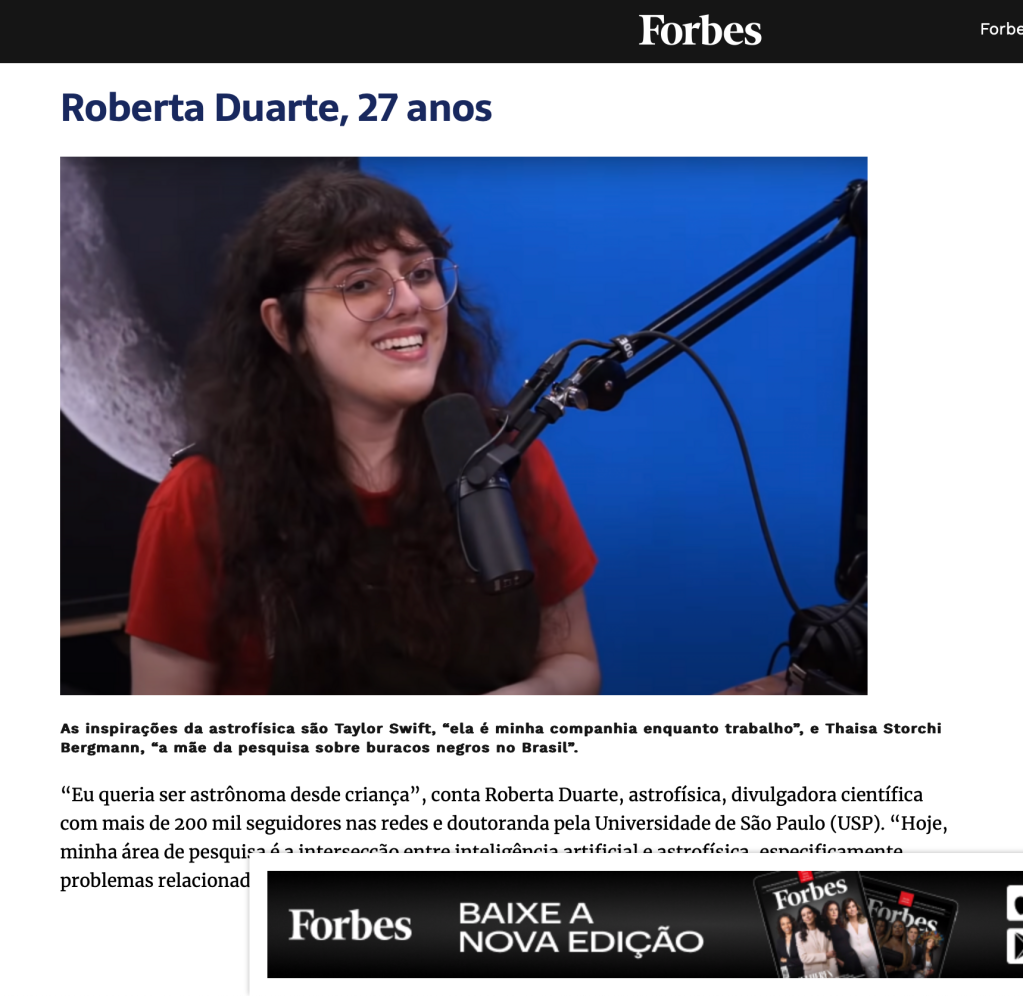
Congrats Roberta on the well-deserved feature! Our group is proud.
Overlord of GPUs and black holes: congrats to Pedro Motta on his MsC defense
Today we had the outstanding MsC defense of Pedro Naethe Motta, entitled “GRMHD simulations of X-ray binaries in the hard state“. There is a lot to unpack here: GRMHD stands for general relativistic magnetohydrodynamic, a technique used by astrophysicists to simulate the motion of plasmas in curved spacetimes.
In this work, Pedro presented a new, computationally efficient method for modeling the radiation processes in black hole X-ray binaries (XRBs), developed using a feature of GPUs called texture memory instead of lookup tables or directly solving the cooling equations. In the dissertation, Pedro extensively tested the new approach and implemented it in the H-AMR GRMHD code. This new approach can be quite useful for studying accretion flows around stellar-mass black holes.
During his masters, Pedro spent five months visiting our collaborator Sasha Tchekhovskoy at Northwestern University who is one of the main groups developing and using H-AMR.
Stay tuned for a paper reporting the results of this work!
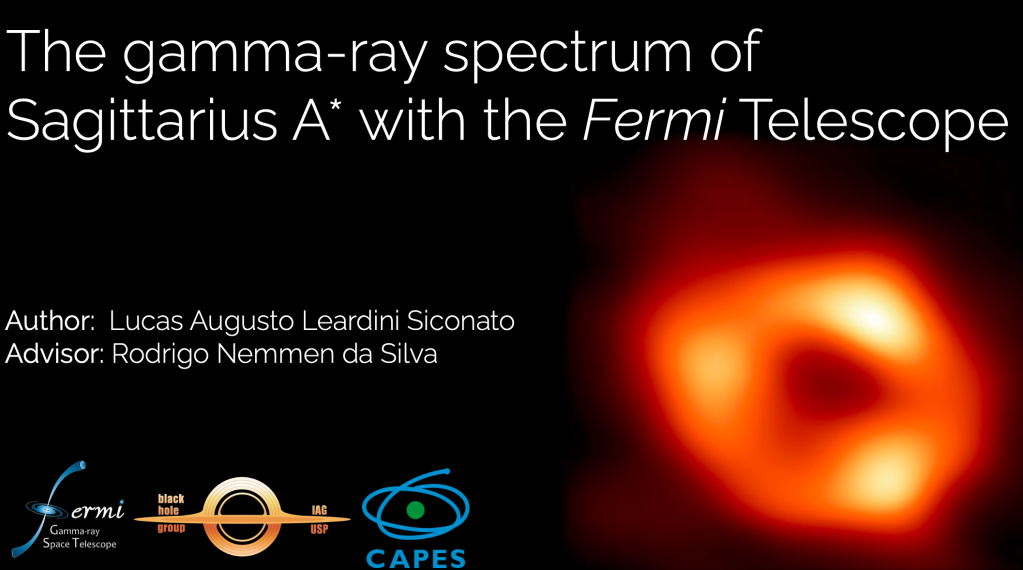
Gamma-rays from the central supermassive black hole in Our Galaxy: Lucas defends his MsC
Today, Lucas Siconato made a fantastic MsC defense, presenting his work analyzing and modeling the gamma-ray spectrum of Sagittarius A*—the supermassive black hole in the Milky Way—using over ten years of observations made with the Fermi Large Area Telescope. Lucas modeled the observations using both leptonic and hadronic scenarios, and the results are intriguing.
Congrats, Lucas! We wish you a fantastic career.
Winds, black holes and galaxies: Ivan got a PhD
I am so so happy that one of the best students I have had the pleasure of working with throughout the years, Ivan Almeida, beautifully defended his FAPESP-funded PhD today, entitled “Winds and feedback from supermassive black holes accreting at low rates”. This was a long journey where I learned more from Ivan than him from me. Ivan finished his graduate school with many first author papers spanning numerical simulations of winds, analytical models, and data modeling using different techniques.
Ivan got multiple postdoc offers, with Asia and Europe competing for him. In the end, his next step will be at Newcastle University. A dramatic change of scenery compared to São Paulo. We wish you a productive and happy career.

New MsC from the group: Douglas Carlos
Douglas F. Carlos just completed his MsC degree in our group, with the work “Gamma-rays from active galactic nuclei in dwarf galaxies”. Congrats Douglas on the great work and defense! I am fulfilled that my group has produced a generation of students in Brazil who are proficient in extracting novel scientific insights from the Fermi LAT observations.
Women in Machine Learning Symposium 2022 with Roberta
Roberta Duarte—a PhD student in our group—presented our research on how data-driven machine learning can have an impact in black hole astrophysics at the Women in Machine Learning Symposium 2022. Watch the presentation below.
 Black Hole Group