Roberta defended her PhD

On June 2nd 2025, Roberta Duarte defended her PhD on operator learning applied to magnetohydrodynamics.

Operator learning is a cutting-edge machine learning technique where we devise a model to learn the operator solution of partial differential equations rather than learning the solutions themselves. Roberta adapted the Fourier neural operator technique to learn to forecast the time evolution of the Orszag-Tang vortex, a classical problem in MHD and used to benchmark and test every numerical MHD code that exists because of the onset of turbulence and shocks.

Roberta beautifully gave her PhD thesis talk and handled questions from the five committee members. The defense started at 2:15pm local time, and ended at 6pm. Yes, a long defense, with rich conversations and discussions.

Congratulations, Dr. Duarte!

We submitted a paper reporting these results. Stay tuned for news.

Oportunidade de iniciação científica: GPUs + buracos negros

Grupo de Buracos Negros tem uma oportunidade de iniciação científica disponível imediatamente. Esperamos candidaturas de estudantes com experiência em programação de linguagem compilada (C) — ou aberto(a)s e empolgado(a)s em aprender — e interesse em aceleração com GPUs. Nossa aplicação científica é calcular a radiação eletromagnética proveniente de discos de acreção ao redor de buracos negros, usando NVIDIA GPUs.

Pré-requisitos:

  • Ótimo histórico de graduação
  • Cursar do terceiro semestre em diante de graduação em computação, astronomia ou física (outros cursos também aceitos)
  • Experiência em programação de baixo nível (ou empolgação em aprender)
  • Interesse em paralelização e GPUs (CUDA)

Interessado(a)s favor enviar um e-mail para o Prof. Rodrigo Nemmen contendo

  • Um breve texto (máximo 250 palavras) descrevendo porque: interesse em fazer IC no meu grupo, experiência prévia em computação e pesquisa (se houver)
  • Histórico escolar de graduação
  • CV ou resume (opcional)

Overlord of GPUs and black holes: congrats to Pedro Motta on his MsC defense

Today we had the outstanding MsC defense of Pedro Naethe Motta, entitled “GRMHD simulations of X-ray binaries in the hard state“. There is a lot to unpack here: GRMHD stands for general relativistic magnetohydrodynamic, a technique used by astrophysicists to simulate the motion of plasmas in curved spacetimes.

In this work, Pedro presented a new, computationally efficient method for modeling the radiation processes in black hole X-ray binaries (XRBs), developed using a feature of GPUs called texture memory instead of lookup tables or directly solving the cooling equations. In the dissertation, Pedro extensively tested the new approach and implemented it in the H-AMR GRMHD code. This new approach can be quite useful for studying accretion flows around stellar-mass black holes.

During his masters, Pedro spent five months visiting our collaborator Sasha Tchekhovskoy at Northwestern University who is one of the main groups developing and using H-AMR.

Stay tuned for a paper reporting the results of this work!

Gamma-rays from the central supermassive black hole in Our Galaxy: Lucas defends his MsC

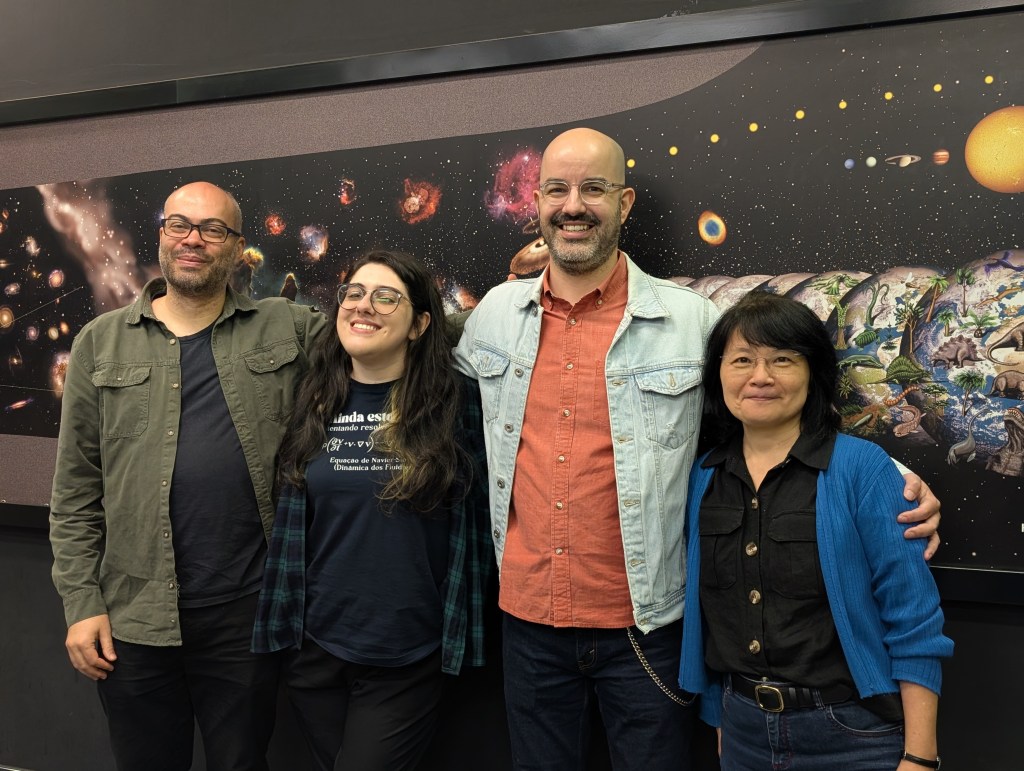
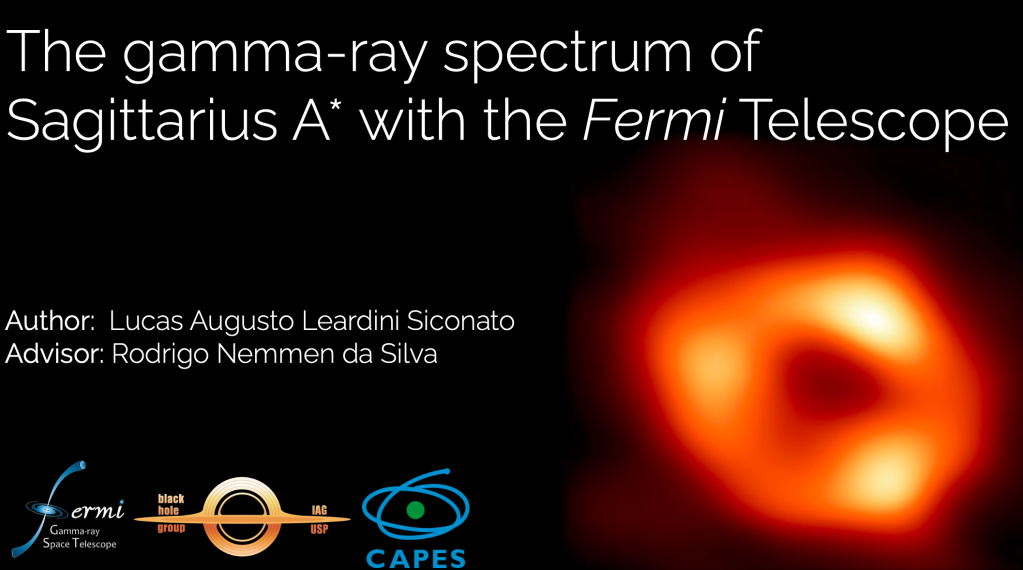
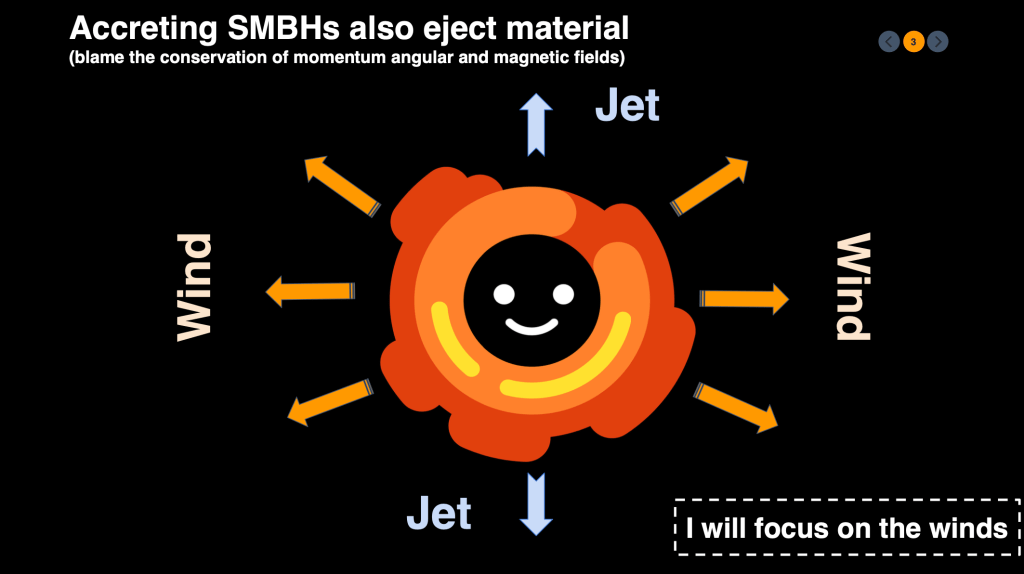
Today, Lucas Siconato made a fantastic MsC defense, presenting his work analyzing and modeling the gamma-ray spectrum of Sagittarius A*—the supermassive black hole in the Milky Way—using over ten years of observations made with the Fermi Large Area Telescope. Lucas modeled the observations using both leptonic and hadronic scenarios, and the results are intriguing.

Congrats, Lucas! We wish you a fantastic career.

Winds, black holes and galaxies: Ivan got a PhD

I am so so happy that one of the best students I have had the pleasure of working with throughout the years, Ivan Almeida, beautifully defended his FAPESP-funded PhD today, entitled “Winds and feedback from supermassive black holes accreting at low rates”. This was a long journey where I learned more from Ivan than him from me. Ivan finished his graduate school with many first author papers spanning numerical simulations of winds, analytical models, and data modeling using different techniques.

Ivan got multiple postdoc offers, with Asia and Europe competing for him. In the end, his next step will be at Newcastle University. A dramatic change of scenery compared to São Paulo. We wish you a productive and happy career.

New MsC from the group: Douglas Carlos

Douglas F. Carlos just completed his MsC degree in our group, with the work “Gamma-rays from active galactic nuclei in dwarf galaxies”. Congrats Douglas on the great work and defense! I am fulfilled that my group has produced a generation of students in Brazil who are proficient in extracting novel scientific insights from the Fermi LAT observations.

Trabalho de doutoranda do grupo é capa do Jornal da USP

Os resultados do projeto de mestrado de Roberta Duarte, atual doutoranda no Grupo de Buracos Negros, foi destaque no Jornal da USP. A pesquisa consistiu da aplicação pioneira de inteligência artificial para simular um buraco negro interagindo com o seu meio ambiente.

Capa do Jornal da USP com o destaque para a pesquisa de Roberta Duarte, doutoranda no Grupo de Buracos Negros.

O artigo reportando os resultados da pesquisa foi recentemente aceito para publicação na revista MNRAS.

Parabéns Roberta pela mais do que merecida repercussão do trabalho!

Paper: Black hole growth in high redshift radio-loud quasars studied with the ESO Very Large Telescope

Our paper, VLT/SINFONI study of black hole growth in high redshift radio-loud quasars from the CARLA survey”has been accepted for publication in the Monthly Notices of the Royal Astronomical Society, and the pre-print appeared on astro-ph today. The paper was led by former graduate student Murilo Marinello, and this work formed a major part of his PhD dissertation published in April this year.

The new study focused on 35 distant, radio-loud quasars, the majority of which were selected from the Clusters Around Radio-Loud AGN (CARLA) survey. These quasars were known to have large black hole masses, emit luminous radio emission, and tend to be found in dense regions of the early universe. Therefore, they are believed to be good candidates for the distant progenitors of massive (elliptical) galaxies that dominate the universe today. The masses of their supermassive black holes had previously been estimated using the virial black hole mass method applied to their SDSS spectra. Due to their high redshifts, however, the only emission line available to make these measurements in these optical SDSS spectra was the CIV line. This line is known to be affected by non-gravitational effects (winds or outflows) and is thus not optimal for the virial black hole mass estimate. In this project, we therefore re-observed the quasars in the near-infrared using the SINFONI spectrograph on the Very Large Telescope in Chile. This allowed us to access the redshifted Ha broad emission line, and thus determine the black hole masses more accurately. This makes a big difference, as can be seen in the figure below showing the nice symmetric Ha line on the top and the distorted CIV line at the bottom for one of our quasars:

LineFit_example

Together with a determination of the accretion rates of the quasars, which can be estimated from their luminosities, the new black hole masses were used to also derive the growth histories of these supermassive black holes. One major finding was that if these quasars had always been accreting at the same rates as measured at the current time, it would not have been possible for them to obtain their high observed masses within the cosmic time available since the Big Bang. The logical conclusion is thus that these quasars must have experienced a phase of much faster growth in the past. This can be nicely illustrated in the following figure:

GROWTH_TRACK_new

The red points are the CARLA quasars from this study. The black solid lines show the growth tracks we found to be the ones describing their most likely histories. These tracks consist of two phases: a rapid growth phase starting from a one thousand solar mass black hole seed at z ~ 20, growing at the Eddington limit to a hundred million or more solar masses at z ~ 6, followed by a second, slower phase at the observed lower Eddington ratios until z ~ 2-3. As such, it is possible that the CARLA quasars are direct descendants of the luminous quasars found at z ~ 6-7.

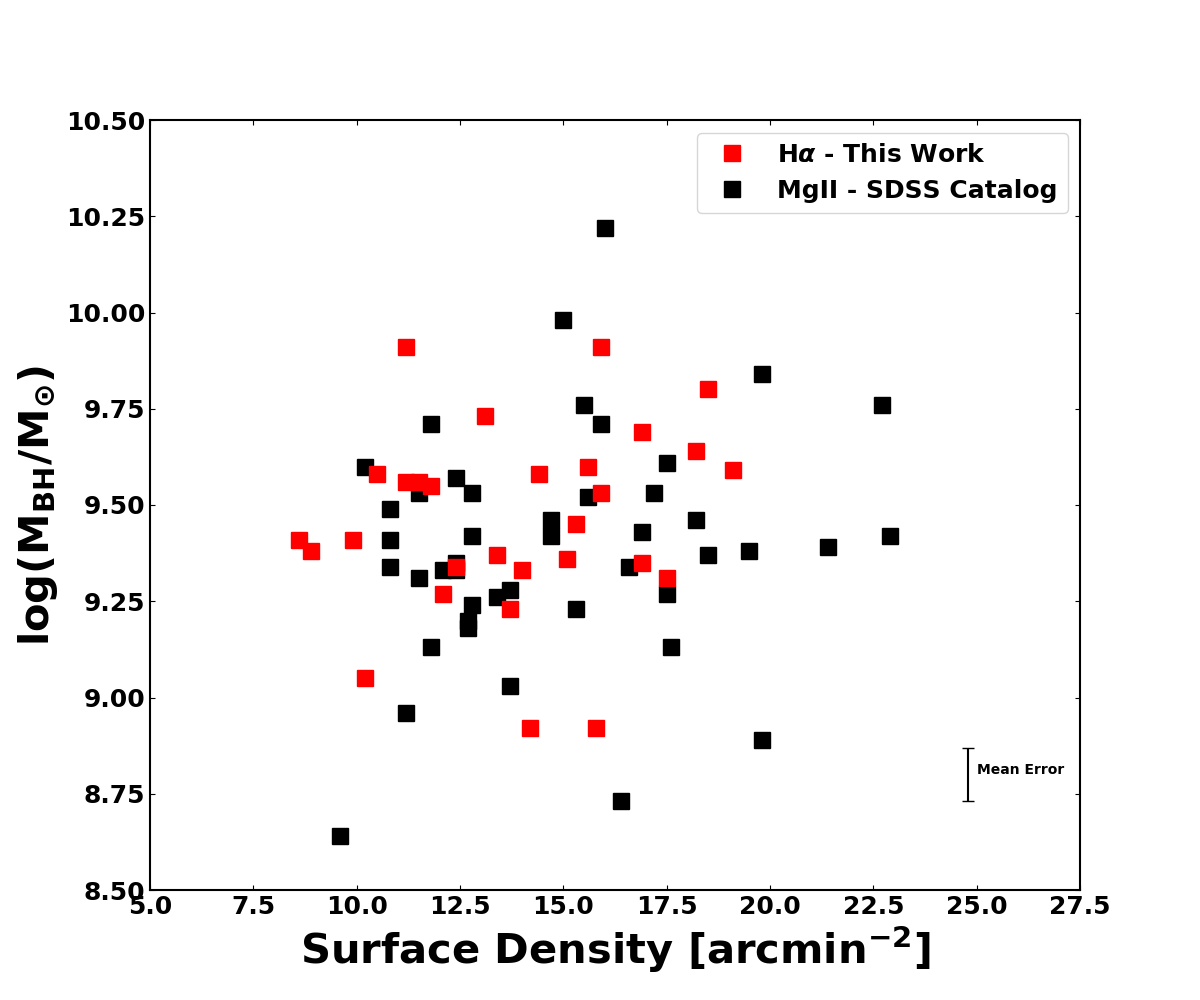
In the local universe, there is a strong correlation between the masses of the supermassive black holes and the masses of their host galaxies. Since the more massive galaxies are also found, on average, in more massive dark matter halos, there is an indirect connection between the mass of the black hole and the mass of its halo. We therefore also tested whether the black holes in the CARLA quasars already “know” that they are located in dense galaxy environments:

SD_MBH_reli1.png

We found a weak, low significance correlation between the black hole masses and the surface density of galaxies that surround them (the latter is a measure of the environment or halo mass of the CARLA quasars), and therefore do not find strong evidence that the most massive CARLA quasars are also in the most dense environments or massive halos. However, these galaxy surface densities had been previously determined with the Spitzer Space Telescope as part of the CARLA project, and are not very precise. In the future, we will therefore focus on trying to obtain more precise measurements of the environments of the CARLA quasars, and test again for possible correlations between black hole mass and environment.


Paper: Optical characterization of WISE selected blazar candidates

Over the last decade more than five thousand gamma-ray sources were detected by the Large Area Telescope (LAT) on board Fermi Gamma-ray Space Telescope. Given the large positional uncertainty of the telescope, nearly 30% of these sources remain without an obvious counterpart in lower energies; these are called unassociated gamma-ray sources (UGSs). This motivated the release of several catalogs of gamma-ray counterpart candidates and several follow up campaigns in the last decade.

Majority is dominated by blazars

Between the associated sources, the large majority is composed by blazars, divided into BL Lacs, with a characteristic lineless spectrum (see figure below), and flat spectrum radio quasars (FSRQs), with broad emission lines and radio spectral index  α < 0.5 (defined by the flux density S_ν ∝ ν^−α). In this sense, some of the most successful catalogs of gamma-ray candidate counterparts are the WISE Blazar-Like Radio-Loud Sources (WIBRaLS) catalog and the Kernel Density Estimation selected candidate BL Lacs (KDEBLLACS) catalog, both selecting blazar-like sources based on their infrared colors from the Wide-field Infrared Survey Explorer (WISE).

In this work we characterized these two catalogs, clarifying the true nature of their sources based on their optical spectra from Sloan Digital Sky Survey (SDSS) data release (DR) 15, thus testing how efficient they are in selecting true blazars. If a WIBRaLS2 or KDEBLLAC source is a true blazar, its spectrum may look like the following:


Results

Based on the optical SDSS spectra, we found that at least ~30% of each catalog is composed by confirmed blazars, with quasars (QSOs) being the major contaminants in the case of WIBRaLS2 (~58%) and normal galaxies in the case of KDEBLLACS (~38.2%). We found that specially in the case of KDEBLLACS, the contaminants are mainly concentrated in the edges of the WISE color-color diagram (see figure below) and can be easily separated from the spectroscopically confirmed BL Lacs.

Some sources in the Fermi-LAT catalogs are considered blazar candidates of uncertain type (BCUs) because the adopted association methods select a counterpart that satisfies at least one of the following conditions: i) An object classified as blazar of uncertain or transitional type in Roma-BZCAT. ii) A source with multiwavelength data indicating a typical two-humped blazar-like spectral energy distribution (SED) and/or a flat radio spectrum. BCUs are divided into three sub-types:

– BCU I: the counterpart has a published optical spectrum which is not sensitive enough for classifying it as FSRQ or BL Lac.

– BCU II: there is no available optical spectrum but an evaluation of the SED synchrotron peak position is possible.

– BCU III: the counterpart shows typical blazar broadband emission and a flat radio spectrum, but lacks a optical spectrum and reliable measurement of the synchrotron peak position.

In 4FGL, 1155 sources are considered as BCUs. Our analysis based on the optical spectra available in SDSS DR15 allowed us to give a conclusive classification for 11 of them: 2 BL Lacs, 4 BL Lacs with spectra dominated by the host galaxy, and 5 FSRQs. The SDSS spectral analysis also allowed us to find 25 new BL Lac objects which will be included in future releases of Roma-BZCAT.

This work contributes to a better understanding of the γ-ray sky in the Fermi-LAT era. In particular, the community will benefit from the characterization of WIBRaLS2 and KDEBLLACS in population studies of blazars and in subsequent programs of spectroscopic follow-up needed to confirm the nature of the UGSs.

The detailed discussion can be found here: https://arxiv.org/abs/1908.05229

This work was supported by FAPESP (Fundação de Ampara à Pesquisa do Estado de São Paulo) under grants 2016/25484-9, 2018/24801-6 and 2017/01461-2; and many other institutions.

fapesp_logo-lowres