Trabalho de doutoranda do grupo é capa do Jornal da USP

Os resultados do projeto de mestrado de Roberta Duarte, atual doutoranda no Grupo de Buracos Negros, foi destaque no Jornal da USP. A pesquisa consistiu da aplicação pioneira de inteligência artificial para simular um buraco negro interagindo com o seu meio ambiente.

Capa do Jornal da USP com o destaque para a pesquisa de Roberta Duarte, doutoranda no Grupo de Buracos Negros.

O artigo reportando os resultados da pesquisa foi recentemente aceito para publicação na revista MNRAS.

Parabéns Roberta pela mais do que merecida repercussão do trabalho!

Mapa do céu em raios gama: Threads no twitter e papel de parede

Para quem desejar mais informações de forma sucinta sobre o mapa mais detalhado já feito do céu em raios gama, preparado pelo nosso grupo usando treze anos de observações do Telescópio Espacial Fermi, vejam as threads abaixo.

Quer usar a nossa imagem como papel de parede do seu smartphone ou PC? Siga os links abaixo.

New organizer for journal club

Big news for our beloved black hole journal club meetings! Ivan will be now the new organizer of this important event in our department.

Fabio Cafardo was in charge of organizing the JC between 2016 and February 2021. Since he is graduating very soon, we now welcome Ivan Almeida to the important role of being the JC organizer. Thanks Fabio for being such a fantastic organizer, paying attention to keeping it on time, asking a lot of questions and making it overall fun! We will miss you.

Welcome Ivan!

Stellar-mass black holes welcome Pedro!

Hi everyone!

My name is Pedro Naethe Motta and I’m a graduate (M.Sc.) student at IAG – USP. I’ve recently graduated in physics at Universidade Federal Fluminense (UFF) in beautiful Rio de Janeiro.

As most undergraduate physics students, I started my journey aiming to understand and study astrophysics. At first, I didn’t have the chance to do that, so I worked in a project about “chaotic dynamical systems” in the mathematics department, deviating from the original plan.

In the meantime, I found out that I didn’t want to pursue this academical journey. I undertook a semester in General Relativity and reached out to my professor, who gave me the opportunity to work and build my undergraduate thesis in astrophysics. My thesis was about the tidal effects in a neutron stars’ binary system and how these effects can help to unravel mysteries of how matter behave in neutron stars’ interior. Since then, I’m passionate about General Relativity and astrophysics.

I’m recently starting my journey at the IAG’s Black Hole Group, studying state transitions in black hole binaries using General Relativity Magnetohydrodynamics (GRMHD) under the supervision of Professor Rodrigo Nemmen.

Artur defends his MsC dissertation

The black hole group has a new master: Artur Vemado defended his MsC dissertation, entitled “radiative cooling and state transitions in stellar mass black holes”. The defense was very successful.

Here, Artur reported his numerical simulations of black hole accretion flows where he incorporated radiative cooling (with some approximations otherwise the problem is essentially intractable!). We observe the self-consistent emergence of a hot corona enveloping a cold thin accretion disk. Artur quantified the inner radius of the thin disk, the size of the corona, and how these properties respond to varying the mass accretion rate onto the black hole. The resulting simulated black holes are similar to observations of stellar mass black holes in binary systems.

We are looking forward to reporting these exciting results on the emergence of the corona (not the covid-19!) and truncated disk in an upcoming publication.

Many thanks to FAPESP funding through grant 2017/25710-1.

Dr. Gustavo R. R. Soares, PhD in Astrophysics

Congratulations to the now Dr. Gustavo R. R. Soares, for a successful PhD thesis defense! 🎉🍾

The thesis is entitled “Accretion discs, jets, and black hole spins: a study of blazars” and was done under my supervision. The whole defense was entirely online, following the social distancing recommendations of the World Health Organization and the São Paulo State government, in order to ensure the safety of all involved with respect to COVID-19.

The defense lasted for almost five hours (!!), with the thesis committee members in two countries—Brasil and US—and in three states in Brasil: Pernambuco, Rio de Janeiro and São Paulo.

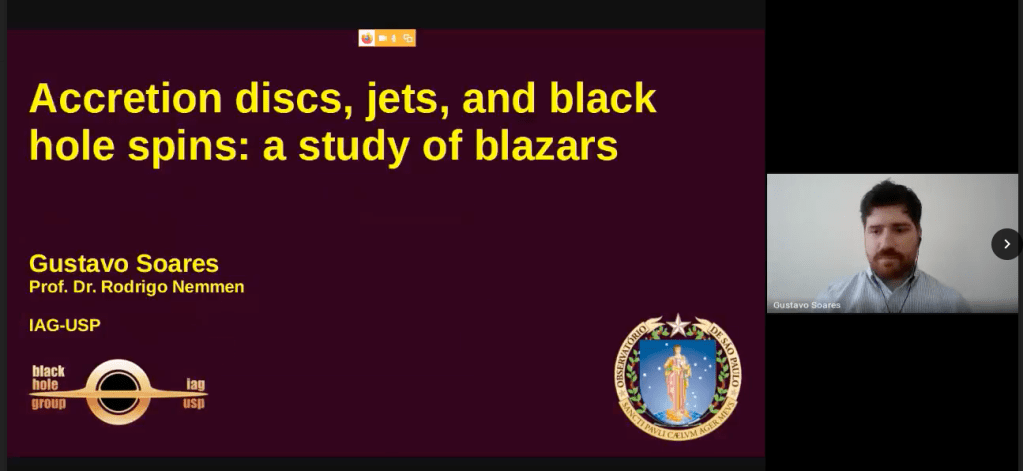
Gustavo presenting his thesis work

Thanks to Dr. Soares’s work, we now we know a bit more about the role of black holes in the universe, and how the supermassive ones power relativistic jets.

Gustavo will begin a postdoc at Oregon State University in the Fall. We are all wishing Gustavo a huge success for his future career!

Our thanks to the Brazilian science funding agencies CAPES, CNPq and FAPESP. Without them, this work would not have been possible.

Paper: Black hole growth in high redshift radio-loud quasars studied with the ESO Very Large Telescope

Our paper, VLT/SINFONI study of black hole growth in high redshift radio-loud quasars from the CARLA survey”has been accepted for publication in the Monthly Notices of the Royal Astronomical Society, and the pre-print appeared on astro-ph today. The paper was led by former graduate student Murilo Marinello, and this work formed a major part of his PhD dissertation published in April this year.

The new study focused on 35 distant, radio-loud quasars, the majority of which were selected from the Clusters Around Radio-Loud AGN (CARLA) survey. These quasars were known to have large black hole masses, emit luminous radio emission, and tend to be found in dense regions of the early universe. Therefore, they are believed to be good candidates for the distant progenitors of massive (elliptical) galaxies that dominate the universe today. The masses of their supermassive black holes had previously been estimated using the virial black hole mass method applied to their SDSS spectra. Due to their high redshifts, however, the only emission line available to make these measurements in these optical SDSS spectra was the CIV line. This line is known to be affected by non-gravitational effects (winds or outflows) and is thus not optimal for the virial black hole mass estimate. In this project, we therefore re-observed the quasars in the near-infrared using the SINFONI spectrograph on the Very Large Telescope in Chile. This allowed us to access the redshifted Ha broad emission line, and thus determine the black hole masses more accurately. This makes a big difference, as can be seen in the figure below showing the nice symmetric Ha line on the top and the distorted CIV line at the bottom for one of our quasars:

LineFit_example

Together with a determination of the accretion rates of the quasars, which can be estimated from their luminosities, the new black hole masses were used to also derive the growth histories of these supermassive black holes. One major finding was that if these quasars had always been accreting at the same rates as measured at the current time, it would not have been possible for them to obtain their high observed masses within the cosmic time available since the Big Bang. The logical conclusion is thus that these quasars must have experienced a phase of much faster growth in the past. This can be nicely illustrated in the following figure:

GROWTH_TRACK_new

The red points are the CARLA quasars from this study. The black solid lines show the growth tracks we found to be the ones describing their most likely histories. These tracks consist of two phases: a rapid growth phase starting from a one thousand solar mass black hole seed at z ~ 20, growing at the Eddington limit to a hundred million or more solar masses at z ~ 6, followed by a second, slower phase at the observed lower Eddington ratios until z ~ 2-3. As such, it is possible that the CARLA quasars are direct descendants of the luminous quasars found at z ~ 6-7.

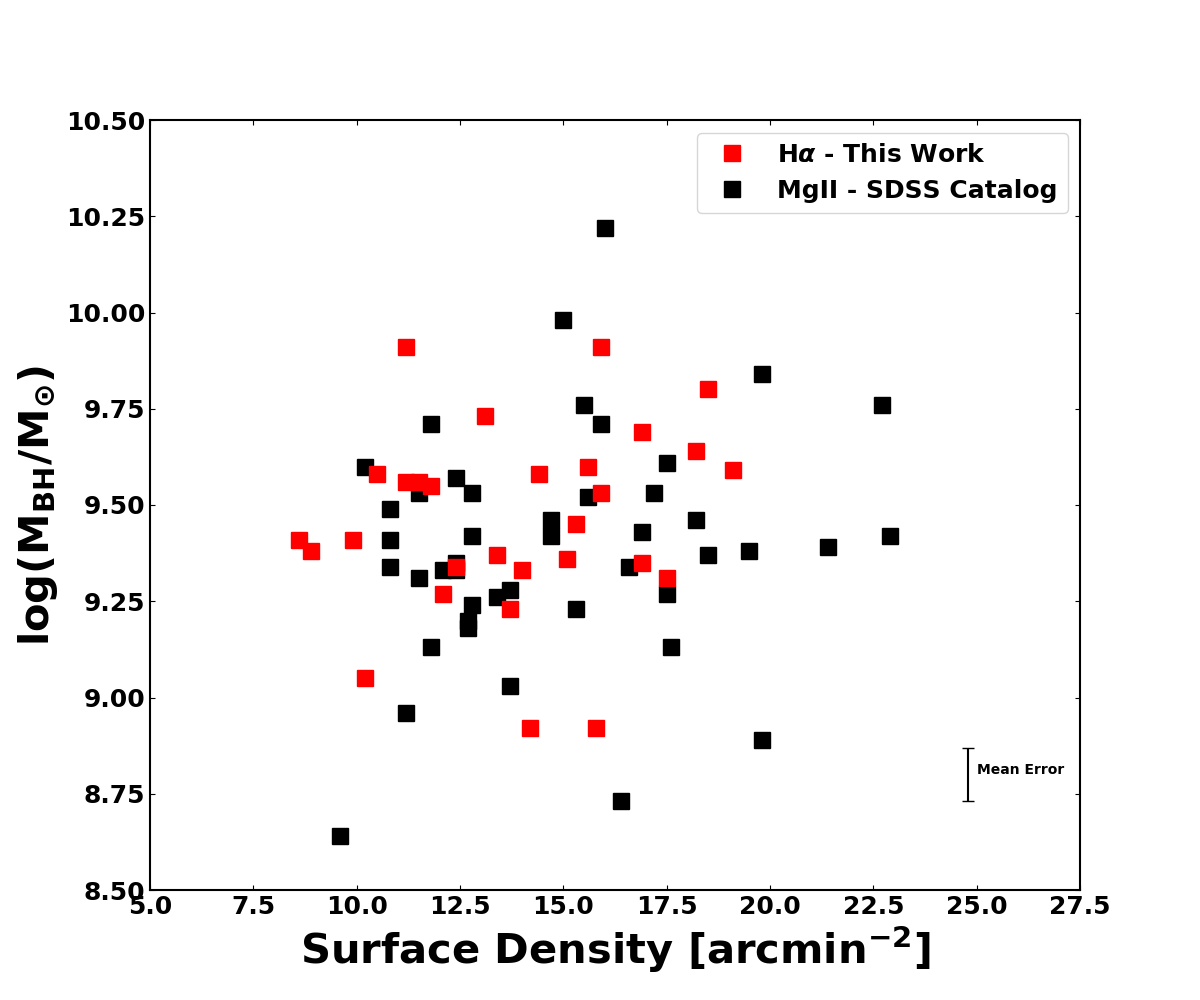
In the local universe, there is a strong correlation between the masses of the supermassive black holes and the masses of their host galaxies. Since the more massive galaxies are also found, on average, in more massive dark matter halos, there is an indirect connection between the mass of the black hole and the mass of its halo. We therefore also tested whether the black holes in the CARLA quasars already “know” that they are located in dense galaxy environments:

SD_MBH_reli1.png

We found a weak, low significance correlation between the black hole masses and the surface density of galaxies that surround them (the latter is a measure of the environment or halo mass of the CARLA quasars), and therefore do not find strong evidence that the most massive CARLA quasars are also in the most dense environments or massive halos. However, these galaxy surface densities had been previously determined with the Spitzer Space Telescope as part of the CARLA project, and are not very precise. In the future, we will therefore focus on trying to obtain more precise measurements of the environments of the CARLA quasars, and test again for possible correlations between black hole mass and environment.


Massive presence of the group at the Brazilian Astronomical Society Meeting

The Black Hole Group had a massive presence at the 43th meeting of the Brazilian Astronomical Society—Sociedade Astronômica Brasileira, SAB.

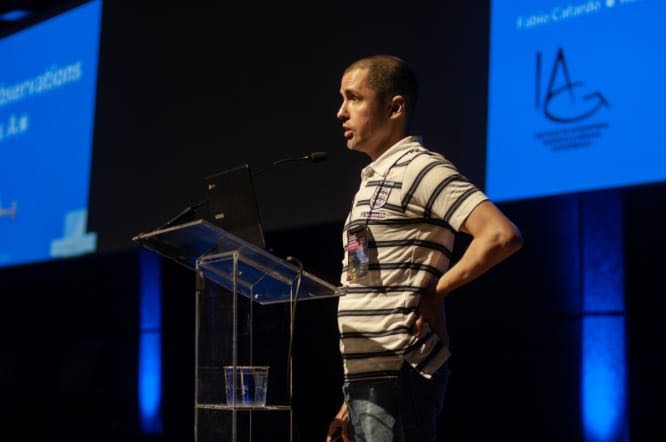
After Marta Volonteri’s review talk on the cosmic evolution of massive black holes, Fabio gave a presentation about the current status of his analysis of Fermi LAT observations of the Galactic Center—we are finishing the first paper of the series which should be submitted very soon.

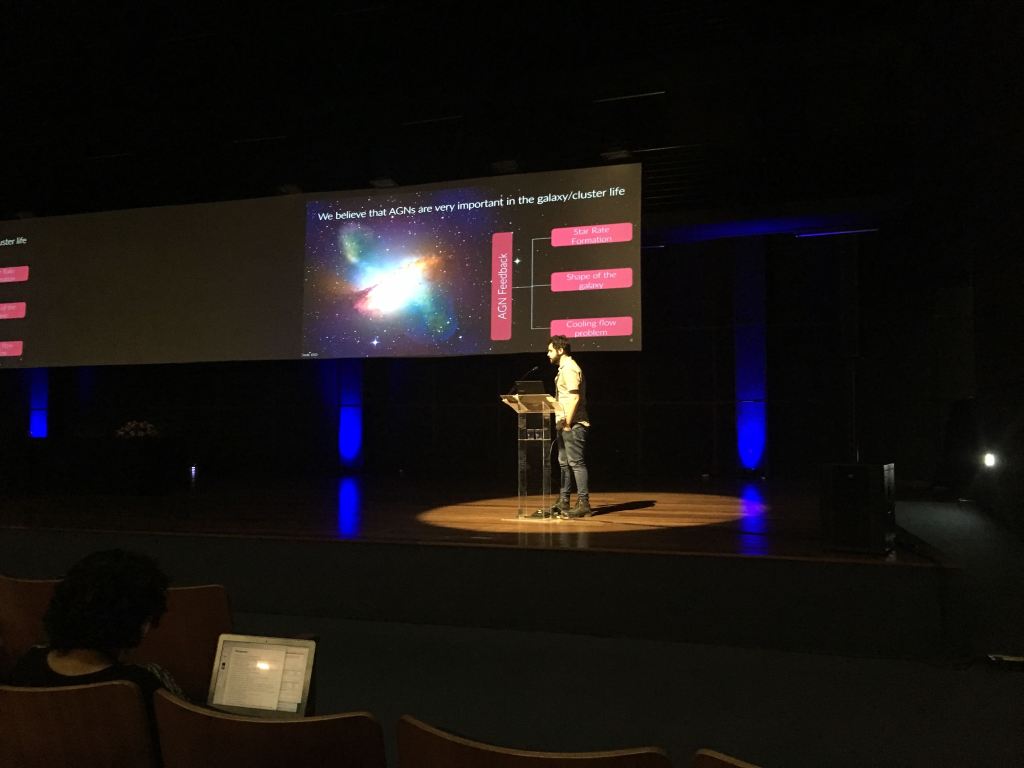
After Fabio’s talk, we’ve had Ivan’s talk on his numerical hydrodynamical simulations of radiatively inefficient accretion flows and their winds.

Roberta Pereira presented her poster on applying deep learning to predict the future of accreting black holes, which are an extreme example of spatiotemporally chaotic systems.

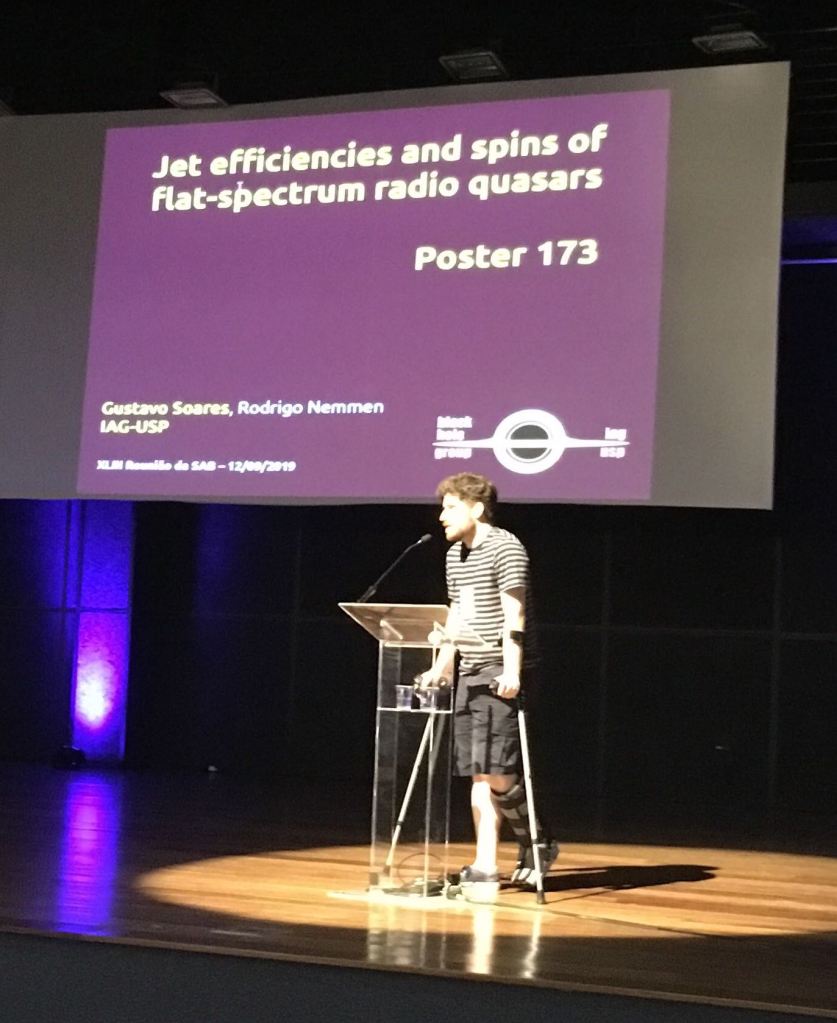
Finally, Gustavo won one of the best poster prizes at the meeting, and was awarded a talk at the meeting. Wait, is that an award? 🙂

Gustavo Soares’s talk at the 43th SAB meeting.

Paper: Optical characterization of WISE selected blazar candidates

Over the last decade more than five thousand gamma-ray sources were detected by the Large Area Telescope (LAT) on board Fermi Gamma-ray Space Telescope. Given the large positional uncertainty of the telescope, nearly 30% of these sources remain without an obvious counterpart in lower energies; these are called unassociated gamma-ray sources (UGSs). This motivated the release of several catalogs of gamma-ray counterpart candidates and several follow up campaigns in the last decade.

Majority is dominated by blazars

Between the associated sources, the large majority is composed by blazars, divided into BL Lacs, with a characteristic lineless spectrum (see figure below), and flat spectrum radio quasars (FSRQs), with broad emission lines and radio spectral index  α < 0.5 (defined by the flux density S_ν ∝ ν^−α). In this sense, some of the most successful catalogs of gamma-ray candidate counterparts are the WISE Blazar-Like Radio-Loud Sources (WIBRaLS) catalog and the Kernel Density Estimation selected candidate BL Lacs (KDEBLLACS) catalog, both selecting blazar-like sources based on their infrared colors from the Wide-field Infrared Survey Explorer (WISE).

In this work we characterized these two catalogs, clarifying the true nature of their sources based on their optical spectra from Sloan Digital Sky Survey (SDSS) data release (DR) 15, thus testing how efficient they are in selecting true blazars. If a WIBRaLS2 or KDEBLLAC source is a true blazar, its spectrum may look like the following:


Results

Based on the optical SDSS spectra, we found that at least ~30% of each catalog is composed by confirmed blazars, with quasars (QSOs) being the major contaminants in the case of WIBRaLS2 (~58%) and normal galaxies in the case of KDEBLLACS (~38.2%). We found that specially in the case of KDEBLLACS, the contaminants are mainly concentrated in the edges of the WISE color-color diagram (see figure below) and can be easily separated from the spectroscopically confirmed BL Lacs.

Some sources in the Fermi-LAT catalogs are considered blazar candidates of uncertain type (BCUs) because the adopted association methods select a counterpart that satisfies at least one of the following conditions: i) An object classified as blazar of uncertain or transitional type in Roma-BZCAT. ii) A source with multiwavelength data indicating a typical two-humped blazar-like spectral energy distribution (SED) and/or a flat radio spectrum. BCUs are divided into three sub-types:

– BCU I: the counterpart has a published optical spectrum which is not sensitive enough for classifying it as FSRQ or BL Lac.

– BCU II: there is no available optical spectrum but an evaluation of the SED synchrotron peak position is possible.

– BCU III: the counterpart shows typical blazar broadband emission and a flat radio spectrum, but lacks a optical spectrum and reliable measurement of the synchrotron peak position.

In 4FGL, 1155 sources are considered as BCUs. Our analysis based on the optical spectra available in SDSS DR15 allowed us to give a conclusive classification for 11 of them: 2 BL Lacs, 4 BL Lacs with spectra dominated by the host galaxy, and 5 FSRQs. The SDSS spectral analysis also allowed us to find 25 new BL Lac objects which will be included in future releases of Roma-BZCAT.

This work contributes to a better understanding of the γ-ray sky in the Fermi-LAT era. In particular, the community will benefit from the characterization of WIBRaLS2 and KDEBLLACS in population studies of blazars and in subsequent programs of spectroscopic follow-up needed to confirm the nature of the UGSs.

The detailed discussion can be found here: https://arxiv.org/abs/1908.05229

This work was supported by FAPESP (Fundação de Ampara à Pesquisa do Estado de São Paulo) under grants 2016/25484-9, 2018/24801-6 and 2017/01461-2; and many other institutions.

fapesp_logo-lowres