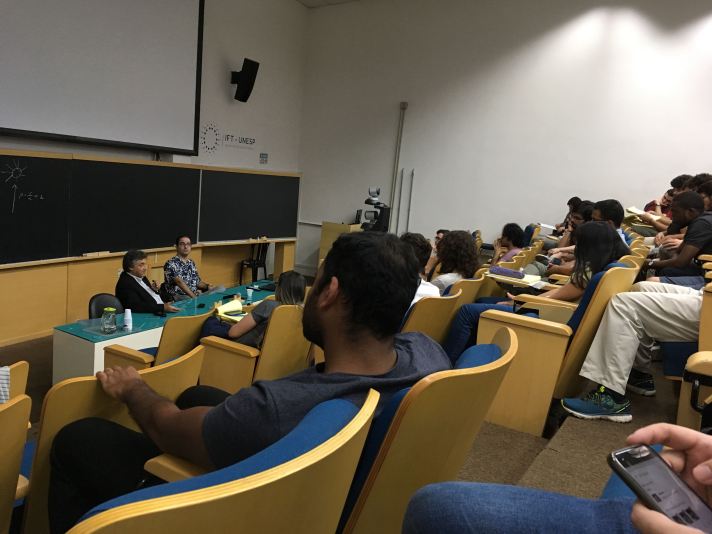
Roberta defended her PhD

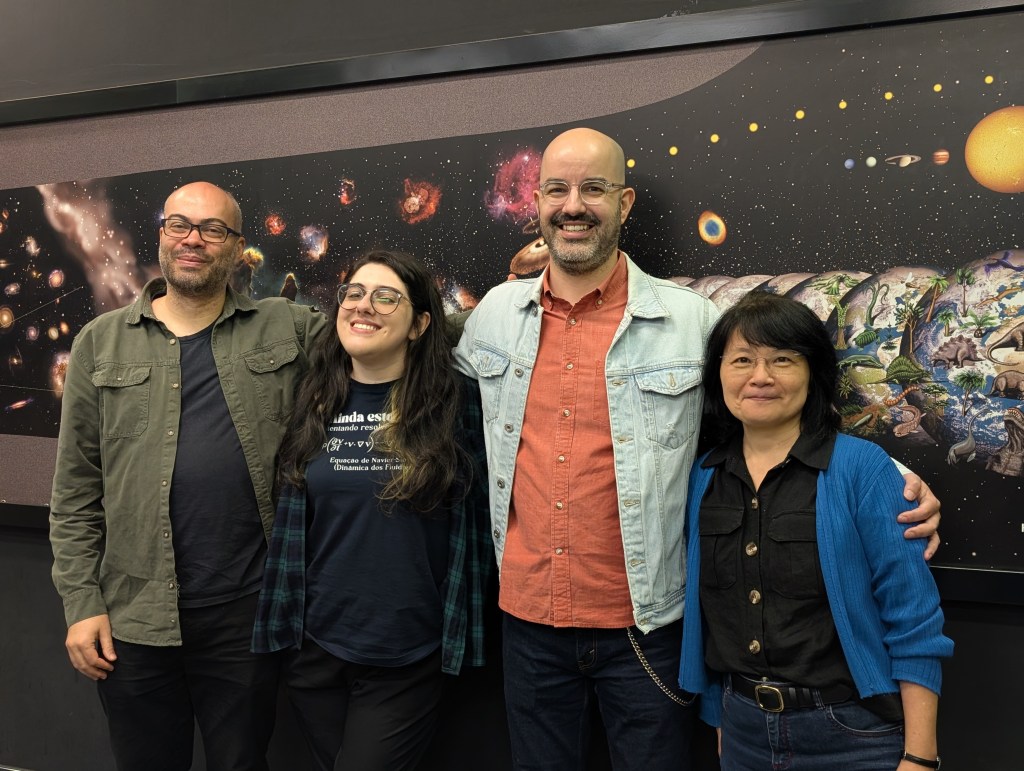
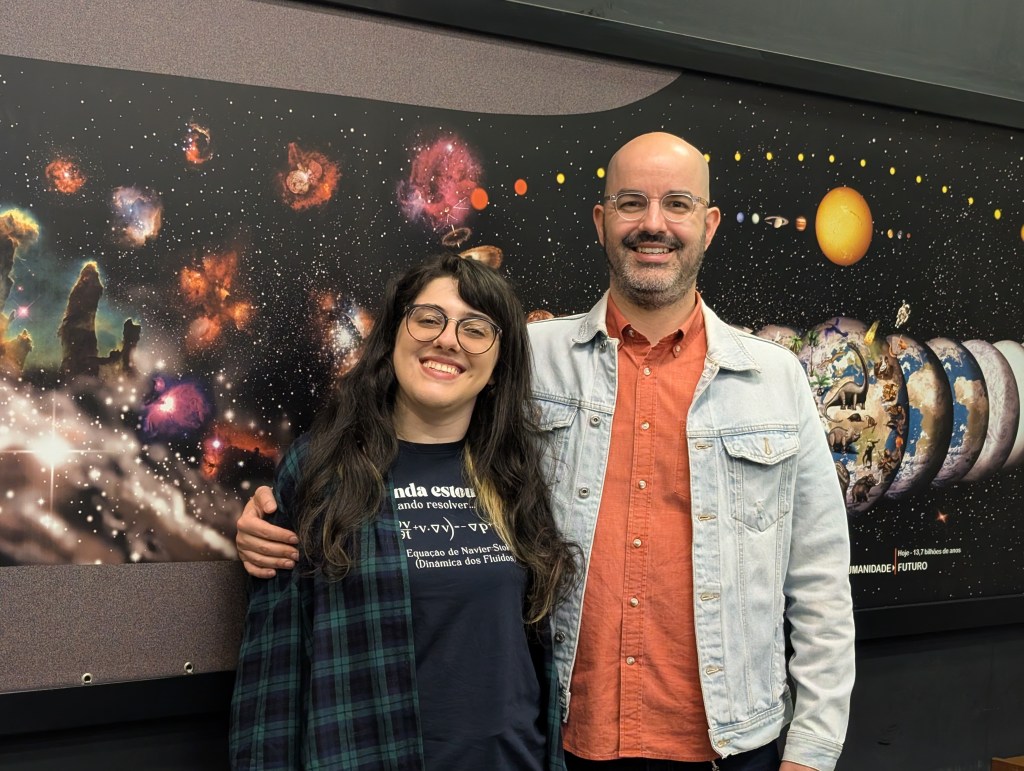
On June 2nd 2025, Roberta Duarte defended her PhD on operator learning applied to magnetohydrodynamics.

Operator learning is a cutting-edge machine learning technique where we devise a model to learn the operator solution of partial differential equations rather than learning the solutions themselves. Roberta adapted the Fourier neural operator technique to learn to forecast the time evolution of the Orszag-Tang vortex, a classical problem in MHD and used to benchmark and test every numerical MHD code that exists because of the onset of turbulence and shocks.

Roberta beautifully gave her PhD thesis talk and handled questions from the five committee members. The defense started at 2:15pm local time, and ended at 6pm. Yes, a long defense, with rich conversations and discussions.

Congratulations, Dr. Duarte!

We submitted a paper reporting these results. Stay tuned for news.
Overlord of GPUs and black holes: congrats to Pedro Motta on his MsC defense

Today we had the outstanding MsC defense of Pedro Naethe Motta, entitled “GRMHD simulations of X-ray binaries in the hard state“. There is a lot to unpack here: GRMHD stands for general relativistic magnetohydrodynamic, a technique used by astrophysicists to simulate the motion of plasmas in curved spacetimes.

In this work, Pedro presented a new, computationally efficient method for modeling the radiation processes in black hole X-ray binaries (XRBs), developed using a feature of GPUs called texture memory instead of lookup tables or directly solving the cooling equations. In the dissertation, Pedro extensively tested the new approach and implemented it in the H-AMR GRMHD code. This new approach can be quite useful for studying accretion flows around stellar-mass black holes.

During his masters, Pedro spent five months visiting our collaborator Sasha Tchekhovskoy at Northwestern University who is one of the main groups developing and using H-AMR.

Stay tuned for a paper reporting the results of this work!

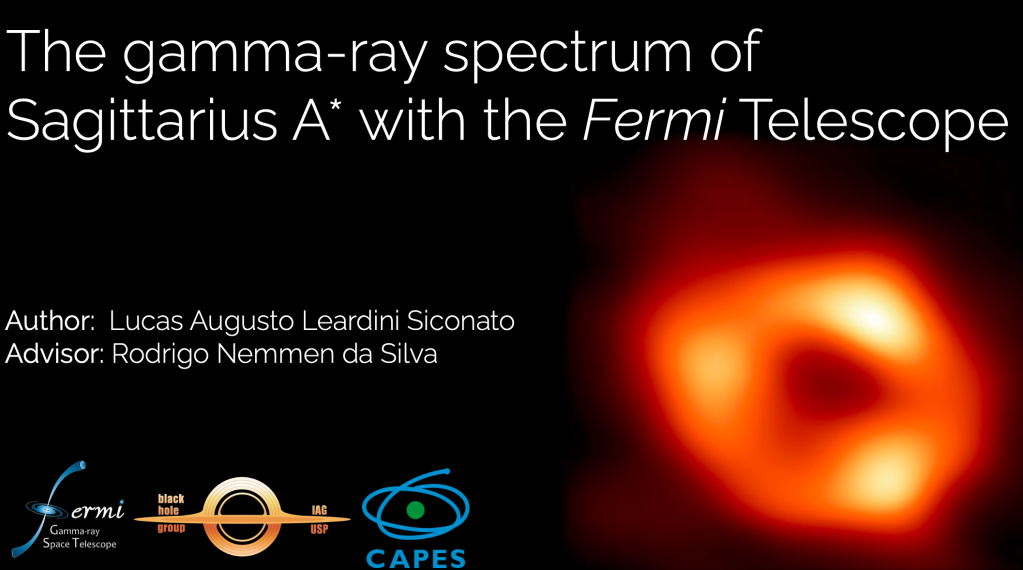
Gamma-rays from the central supermassive black hole in Our Galaxy: Lucas defends his MsC

Today, Lucas Siconato made a fantastic MsC defense, presenting his work analyzing and modeling the gamma-ray spectrum of Sagittarius A*—the supermassive black hole in the Milky Way—using over ten years of observations made with the Fermi Large Area Telescope. Lucas modeled the observations using both leptonic and hadronic scenarios, and the results are intriguing.

Congrats, Lucas! We wish you a fantastic career.

Winds, black holes and galaxies: Ivan got a PhD

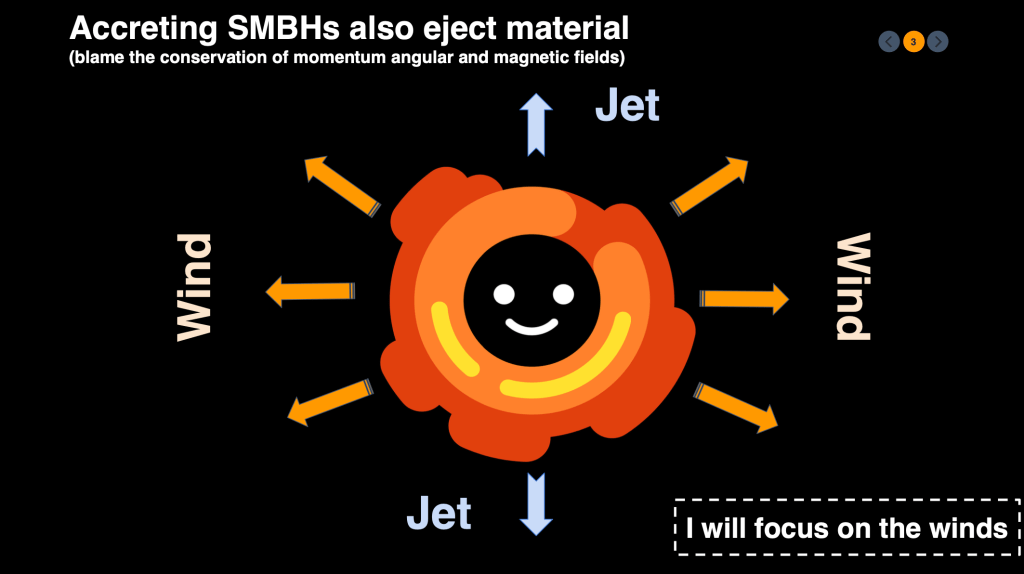
I am so so happy that one of the best students I have had the pleasure of working with throughout the years, Ivan Almeida, beautifully defended his FAPESP-funded PhD today, entitled “Winds and feedback from supermassive black holes accreting at low rates”. This was a long journey where I learned more from Ivan than him from me. Ivan finished his graduate school with many first author papers spanning numerical simulations of winds, analytical models, and data modeling using different techniques.

Ivan got multiple postdoc offers, with Asia and Europe competing for him. In the end, his next step will be at Newcastle University. A dramatic change of scenery compared to São Paulo. We wish you a productive and happy career.

Pedro Cézar successfully defended his MsC dissertation

Let’s congratulate Pedro Henrique Cezar Remião de Macedo on his outstanding MsC defense! Pedro presented his work “The many faces of the Seyfert galaxy NGC 5643”.

In this work, Pedro presented a comprehensive analysis of NGC 5643’s central region, using high-resolution spectroscopy to explore the structure of the ionization bicone and gas kinematics, uncovering evidence of AGN-driven outflows and suggesting the influence of a radio jet on the ionization and motion of the galactic gas.

Pedro will do his PhD at the Instituto de Astrofísica de Canarias, studying dust in the nuclear regions of active galaxies. Here’s to a great career!

Dr. Gustavo R. R. Soares, PhD in Astrophysics

Congratulations to the now Dr. Gustavo R. R. Soares, for a successful PhD thesis defense! 🎉🍾

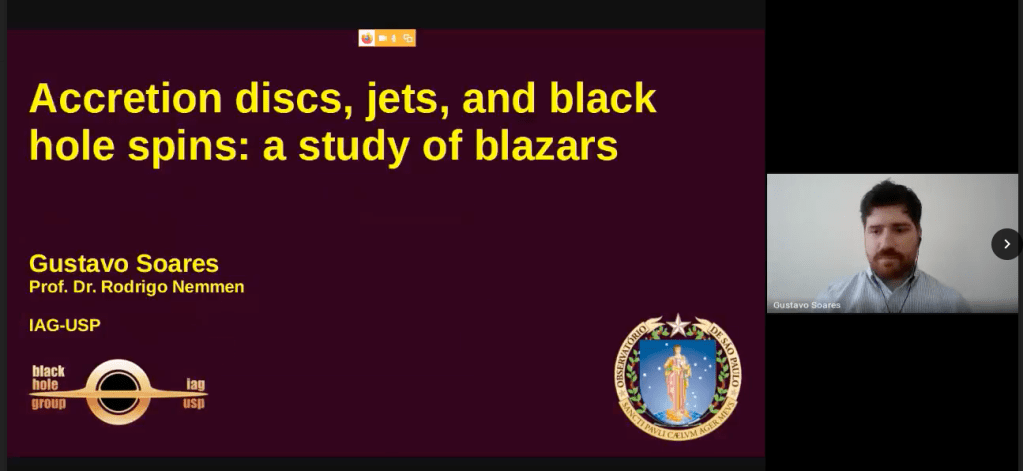
The thesis is entitled “Accretion discs, jets, and black hole spins: a study of blazars” and was done under my supervision. The whole defense was entirely online, following the social distancing recommendations of the World Health Organization and the São Paulo State government, in order to ensure the safety of all involved with respect to COVID-19.

The defense lasted for almost five hours (!!), with the thesis committee members in two countries—Brasil and US—and in three states in Brasil: Pernambuco, Rio de Janeiro and São Paulo.

Gustavo presenting his thesis work

Thanks to Dr. Soares’s work, we now we know a bit more about the role of black holes in the universe, and how the supermassive ones power relativistic jets.

Gustavo will begin a postdoc at Oregon State University in the Fall. We are all wishing Gustavo a huge success for his future career!

Our thanks to the Brazilian science funding agencies CAPES, CNPq and FAPESP. Without them, this work would not have been possible.

Massive presence of the group at the Brazilian Astronomical Society Meeting

The Black Hole Group had a massive presence at the 43th meeting of the Brazilian Astronomical Society—Sociedade Astronômica Brasileira, SAB.

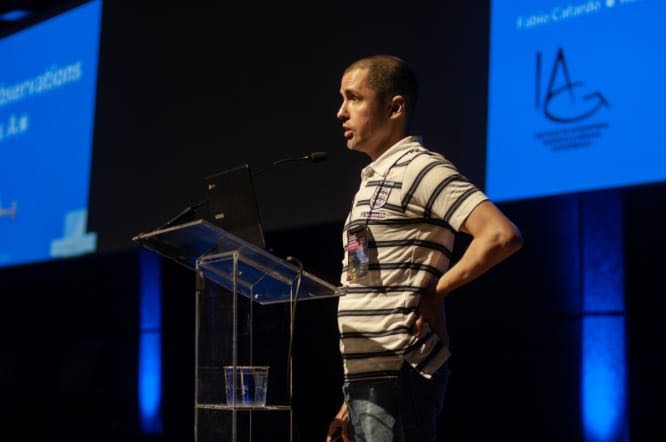
After Marta Volonteri’s review talk on the cosmic evolution of massive black holes, Fabio gave a presentation about the current status of his analysis of Fermi LAT observations of the Galactic Center—we are finishing the first paper of the series which should be submitted very soon.

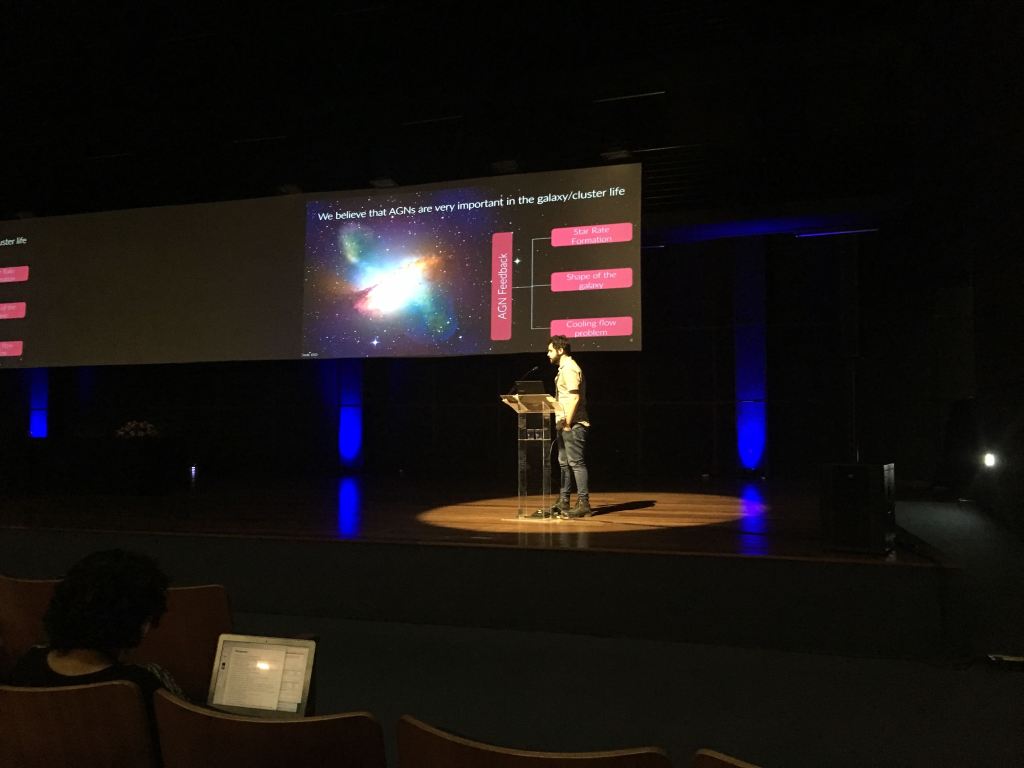
After Fabio’s talk, we’ve had Ivan’s talk on his numerical hydrodynamical simulations of radiatively inefficient accretion flows and their winds.

Roberta Pereira presented her poster on applying deep learning to predict the future of accreting black holes, which are an extreme example of spatiotemporally chaotic systems.

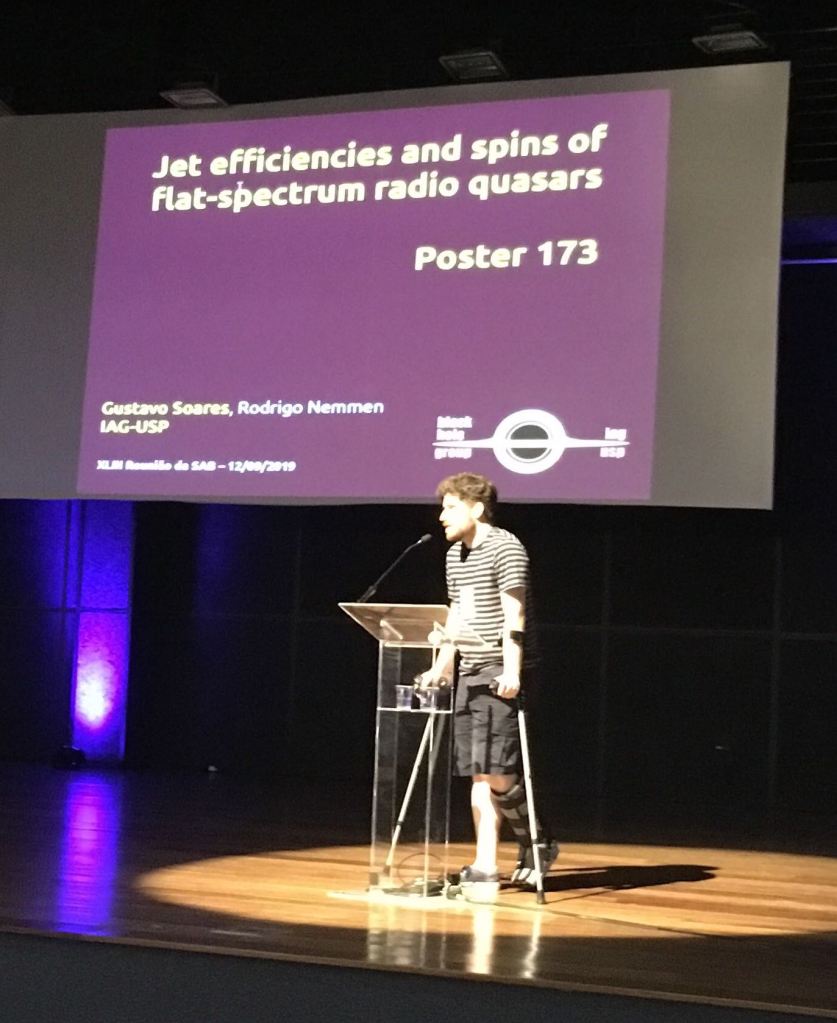
Finally, Gustavo won one of the best poster prizes at the meeting, and was awarded a talk at the meeting. Wait, is that an award? 🙂

Gustavo Soares’s talk at the 43th SAB meeting.

Group taught course at ICTP-SAIFR high-energy astrophysics school

From August 8 to 13, our group taught two courses at the high-energy astrophysics school at ICTP-SAIFR. The first was taught by myself and gave a broad overview of the active galactic nuclei phenomenon, including blazars. The second course was about Fermi LAT observations and taught by Fabio Cafardo, a PhD student in the group who is working of gamma-ray astronomy.

Fabios’s lecture also included a fun hands-on tutorial, teaching the students to analyze gamma-ray observations of the blazar TXS 0506+056. This is the famous blazar which was observed to emit gamma-rays flares and produce a high-energy neutrino at the same time: the second source ever observed in multimessenger astronomy. The first was the neutron star collision observed in gravitational waves with LIGO/Virgo and electromagnetic radiation.

Here is the official abstract for the AGNs and blazars course:

I will give a broad overview of the phenomenology and theory behind the active galactic nuclei (AGN) phenomenon. I will give a particular emphasis on systems which produce relativistic jets such as blazars, given their importance in multimessenger astronomy. I will cover the basic physics of gas accretion and jet production from Kerr black holes. I will also give an overview of the electromagnetic signature from AGNs and blazars, focusing on their gamma-ray emission commonly observed with the Fermi, HESS, MAGIC telescopes, and in the future CTA.

And here is the official description of the Fermi LAT tutorial:

The Fermi Gamma-ray Observatory has revolutionized our understanding of the high-energy universe. Over the last 10 years, the Fermi Large Area Telescope has been observing the entire sky from space every three hours in the 100 MeV to 500 GeV energy range. In this lab activity, We will give a short presentation highlighting the main results and importance of the Fermi Telescope—particularly for blazar and dark matter indirect searches. The talk will be followed by a hands-on tutorial where the students will get familiar with the analysis of space-based gamma-ray observations. 

Here is the material that we covered:

  1. Active galactic nuclei and blazars (Nemmen). Two lectures, 3 hours. Lecture 1, lecture 2
  2. Fermi LAT (Cafardo). Lecture, 1 hour
  3. Fermi LAT hands-on session (Cafardo). 1.5 hours

If you want to run tutorial #3 at home, you can download all the material from the third lecture and perform the analysis without needing to install a lot of additional software. We prepared the tutorial such that you only need to install one software and run an install script.

I suggested some reading for the students interested in diving deeper into AGN physics:

  1. Physical processes in active galactic nuclei, Blandford (cf. from p171 onwards in the PDF). Even though this is a quite dated treatment—from 20 years ago!—and a lot has changed since then, this paper does a great job in summarising the basic physics of the AGN phenomenon. 
  2. Relativistic jets in active galactic nuclei, arXiv:1812.06025. Up-to-date review about AGN jets
  3. Foundations of black hole accretion disk theory. Focuses on black hole accretion, with a general relativistic treatment

Here are some pictures from the event.

Rodrigo Nemmen and Pasquale Blasi tackling questions from the audience. Credit: Ivan Almeida.
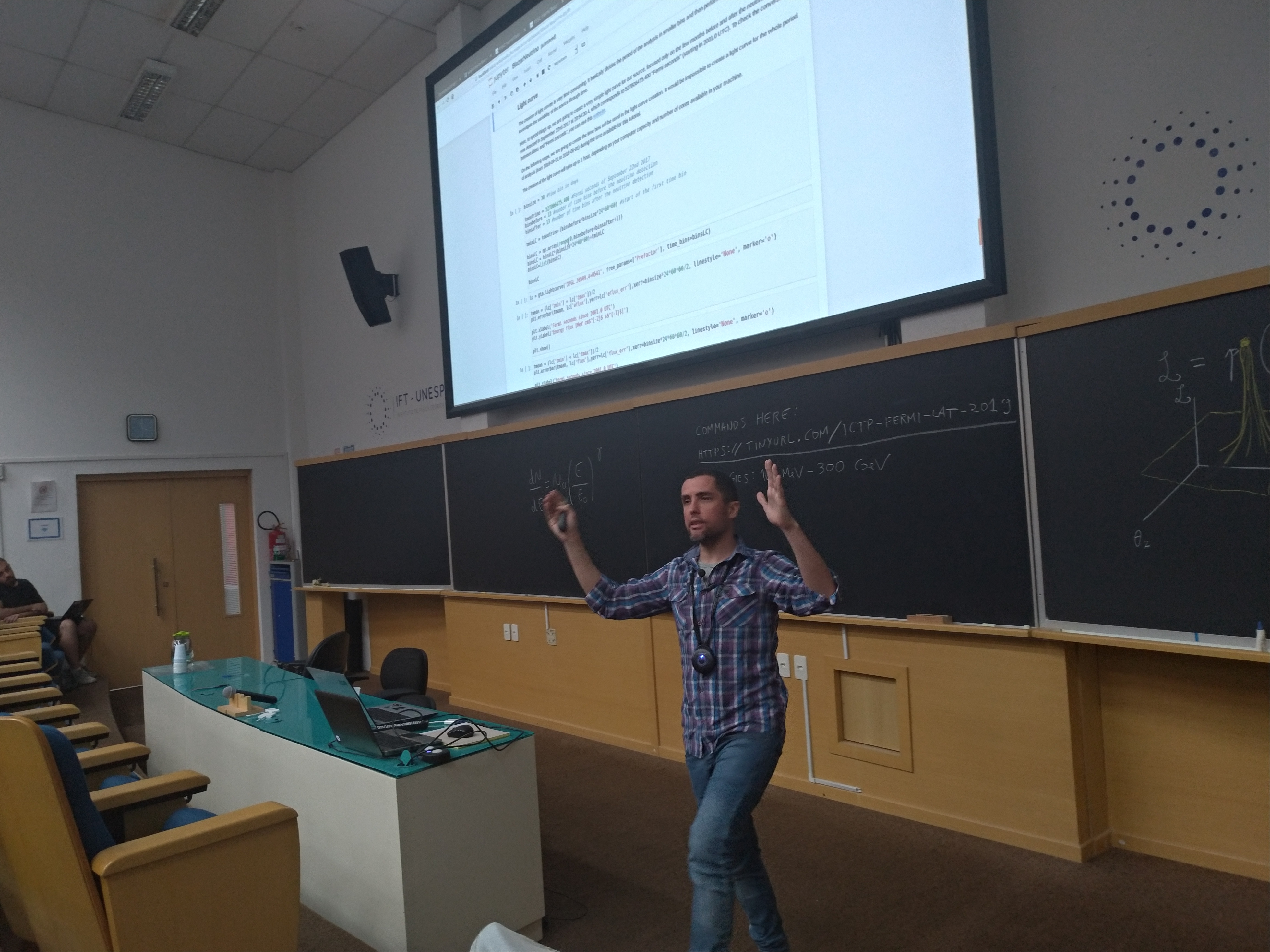
Fabio Cafardo teaching the Fermi LAT hands-on tutorial. Credit: Rodrigo.
Another shot of Fabio during his course. Credit: Ivan.
Some of the diverse audience at the school. Credit: Fabio.

Thanks Fabio Iocco for the invitation. This was fun!

Course on General Relativistic Magnetohydrodynamics by Yosuke Mizuno

Yosuke Mizuno (Goethe University, Frankfurt) taught an advanced course on general relativistic magnetohydrodynamics on August 13-17 at our institute. General relativistic magnetohydrodynamics—or GRMHD—is an essential tool to model high-energy astrophysical phenomena such as accreting black holes and relativistic jets—precisely the type of phenomena that our group loves and cherishes. This course was very useful for everybody in the group. 

The slides are available on this website.

IMG_2194
Yosuke Mizuno lecturing about GRMHD at IAG USP. Credit: Rodrigo Nemmen.

His visit was supported by FAPESP grant 2013/10559-5.